

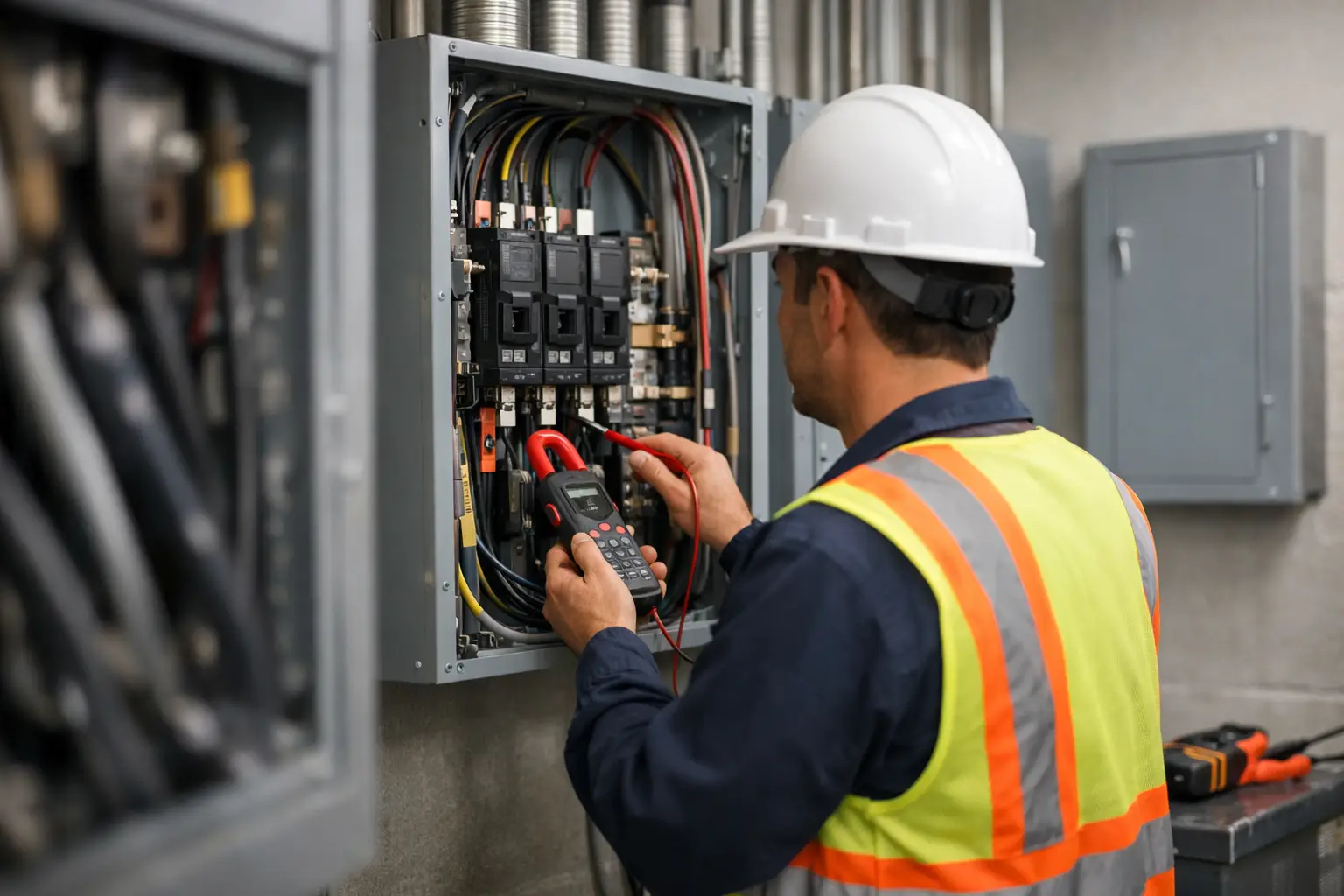
A commercial panel that is already full is more than an inconvenience. It can delay a new piece of equipment, complicate a tenant build-out, and leave a business exposed to nuisance tripping or unsafe workarounds. To size commercial electrical service correctly, you need a real picture of what the building uses now, what it will use next, and how those loads operate together.
A service that is too small creates limits from day one. A service that is oversized without a reason can add unnecessary cost to the project. The right answer comes from a proper load calculation, not a guess based on the size of the building or the rating of the existing panel.
How to Size Commercial Electrical Service
Commercial electrical service sizing starts with the building’s actual electrical loads. That includes general lighting and receptacles, but it also includes the equipment that keeps the business operating: HVAC systems, kitchen equipment, motors, IT equipment, refrigeration, signage, pumps, specialty machinery, and vehicle chargers.
The service is usually described by amperage and voltage. A small office or retail suite may operate on a 120/208-volt, three-phase service, while a shop, warehouse, or facility with larger motors may need 277/480-volt, three-phase power. Voltage matters because it affects the equipment that can be installed and the size of conductors, breakers, transformers, and distribution equipment required.
A larger panel alone does not mean the service is large enough. The meter equipment, main disconnect, service conductors, transformer capacity, and utility supply all need to support the planned load. Every part of the system has to work together.
Start with the equipment list
The first practical step is creating a complete equipment schedule. This should cover permanent equipment as well as planned additions. A restaurant, for example, may have refrigeration, electric cooking equipment, make-up air units, exhaust fans, water heaters, point-of-sale equipment, and exterior lighting. A small manufacturing shop may have welders, air compressors, lifts, dust collection, and motor-driven machinery.
Nameplate ratings are the starting point. Equipment labels identify voltage, phase, amperage, horsepower, watts, or kilowatts. An electrician uses that information to determine the load each item places on the electrical system.
Do not leave out equipment that seems minor. Several countertop appliances, office workstations, display lighting, or unit heaters can add up quickly. The same goes for exterior circuits, security lighting, gate operators, sump pumps, and future tenant needs.
Separate continuous and noncontinuous loads
Not every electrical load runs the same way. Some loads operate for three hours or more at a time and are treated as continuous loads under electrical code. Lighting in a business, certain HVAC loads, and EV charging are common examples. These loads generally require additional capacity because the equipment and conductors must handle sustained operation safely.
Other loads are intermittent. A copier, garage door operator, or occasional-use tool may not run long enough to be treated the same way. The difference matters. Simply adding every breaker rating in a panel is not an accurate way to calculate service size.
An electrician also accounts for the largest motor load. Motors draw additional current during startup, and the calculation must recognize that demand. This is especially important in shops, commercial kitchens, and buildings with larger HVAC equipment.
Apply demand factors instead of adding everything at full load
A building may have dozens of circuits, but not every circuit will reach maximum use at the same time. Electrical code provides demand factors that allow qualified electricians to calculate a realistic service load while maintaining safety margins.
For example, a retail store may have many receptacles available for displays, cleaning equipment, and office devices. That does not mean every receptacle is expected to operate at its full breaker rating at the same moment. On the other hand, a commercial kitchen’s fixed cooking equipment may create a very different demand profile, particularly during peak service hours.
This is where experience matters. The code calculation establishes the minimum requirements, while knowledge of how the business operates helps identify where extra capacity makes sense. A building with a predictable daytime load needs a different plan than a facility with overnight refrigeration, heavy machinery, or charging equipment operating after hours.
Plan for Growth Before the Walls Are Closed
A service upgrade is disruptive once a business is open. It may involve utility coordination, shutdown planning, new conduits, larger feeders, equipment replacement, and inspection. Planning for reasonable future demand during construction or renovation is often less expensive than reopening walls and replacing major equipment later.
Future growth does not mean installing the biggest possible service without a plan. It means identifying likely changes. A retail tenant may add more display lighting or point-of-sale stations. A medical or professional office may add imaging equipment, servers, or additional treatment rooms. A warehouse may add lifts, dock equipment, electric forklifts, or EV chargers.
Leave practical room in the distribution equipment as well. Panel space is not the same as electrical capacity, but both matter. A panel can have spare breaker spaces while the service is at its calculated limit. It can also have enough capacity but no clean way to add circuits without a subpanel or equipment replacement.
For many small-to-midsize commercial properties, planning for future circuits, conduit pathways, and a reasonable amount of spare capacity is a smart investment. The right amount depends on the business, the building, and the owner’s plans for the space.
Common Reasons a Commercial Service Comes Up Short
An older building may have been properly sized when it was built but no longer meet the needs of its current tenant. Business equipment has changed, lighting has expanded, and modern operations depend on more electronics than they did years ago.
Four situations commonly reveal that a commercial electrical service needs attention:
- A new HVAC unit, kitchen appliance, motor, or machine cannot be added without overloading existing equipment.
- Breakers trip during busy operating hours, especially when multiple systems start or run together.
- A tenant improvement project requires more circuits, higher voltage equipment, or additional panels.
- The business wants EV charging, upgraded exterior lighting, backup power, or other modern electrical additions.
Tripped breakers do not automatically mean the entire service must be replaced. The issue could be a single overloaded circuit, a failing breaker, a poor connection, or a load that was installed incorrectly. A proper evaluation identifies the real problem before money is spent on an upgrade.
Service Size Is More Than the Main Breaker
A 200-amp main breaker does not tell the full story of a commercial electrical system. The condition and rating of the panelboard, feeder conductors, meter base, disconnects, grounding system, and utility equipment all matter. In three-phase systems, electricians must also consider load balance across phases.
An unbalanced system can create performance problems and place unnecessary stress on equipment. For example, if most of the 120-volt loads are placed on one phase, that phase may carry substantially more current than the others. Good circuit planning distributes loads as evenly as practical.
The utility connection must also be part of the conversation. An electrical contractor can calculate the building load and design the service equipment, but the utility may need to confirm transformer capacity, available service voltage, meter requirements, and the process for a larger connection. This coordination should happen early, especially for projects involving major equipment or a new commercial build-out.
Why Code-Compliant Sizing Protects the Business
Commercial service sizing must follow the National Electrical Code and local requirements. Permits and inspections are not paperwork to work around. They verify that the system is designed and installed with safe conductor sizing, proper overcurrent protection, grounding, clearances, and equipment ratings.
A code-compliant installation also supports insurance requirements, future renovations, property value, and tenant safety. Cutting corners with undersized conductors, overloaded panels, or improvised equipment connections can lead to equipment damage, lost operating time, or serious fire and shock hazards.
For Bowling Green businesses and nearby property owners, M Power Electric LLC can assess existing equipment, calculate the load for planned improvements, and complete commercial upgrades with the jobsite coordination a working business needs. The goal is not to sell capacity you will never use. It is to install a safe, dependable electrical foundation for the work your building needs to do.
Before ordering equipment or signing off on a new tenant layout, have the electrical demand reviewed. A clear load calculation now gives you room to make decisions with confidence instead of discovering the limits of the service after the project is underway.
Leave a Reply