

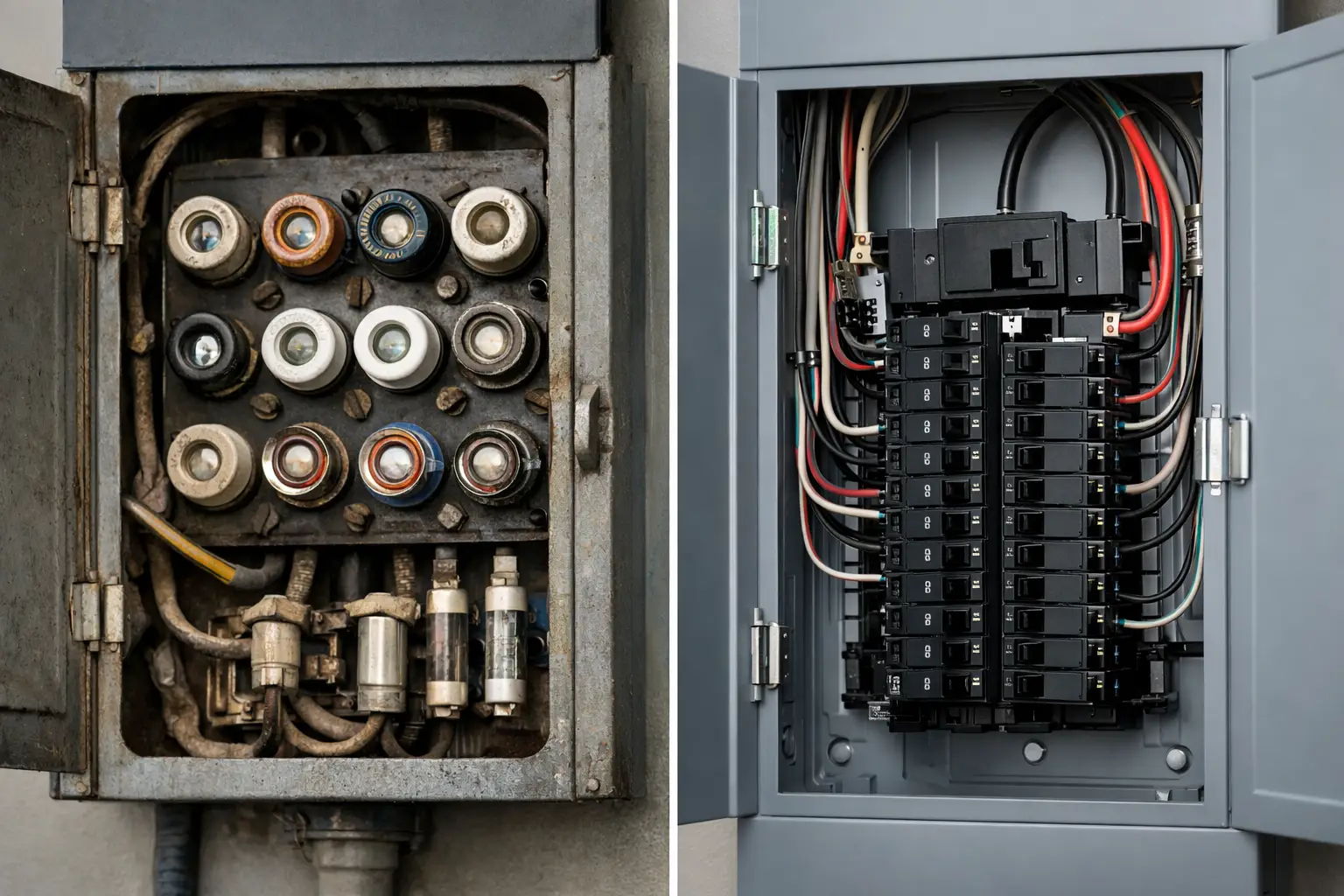
If you pull the cover off an older electrical system and see round screw-in fuses instead of switches, you are looking at a different era of wiring. The fuse box vs breaker panel question usually comes up when a homeowner is buying an older house, planning a renovation, adding heavy-use equipment, or dealing with power problems that keep coming back. And in most cases, the answer is less about nostalgia and more about safety, capacity, and whether your electrical system can handle how you live now.
Fuse box vs breaker panel: the basic difference
A fuse box and a breaker panel do the same main job. They protect your electrical circuits from overloads and short circuits. The difference is in how they react when something goes wrong.
A fuse contains a small metal strip that melts when too much current passes through it. Once that fuse blows, it has to be replaced. A circuit breaker trips a switch instead. After the problem is addressed, the breaker can usually be reset.
That sounds like a small difference, but it matters in day-to-day use. A breaker panel is easier to manage, easier to expand in many cases, and generally better suited for homes and commercial spaces with modern electrical demands.
Why older fuse boxes still exist
Many older homes in Kentucky and across the country were built when electrical usage looked very different. A few lights, a refrigerator, maybe a window AC unit, and fewer receptacles per room was normal. Back then, a fuse box could do the job.
The problem is that houses changed faster than many electrical systems did. Today, the same home may have multiple TVs, kitchen appliances, HVAC equipment, garage tools, computers, chargers everywhere, and maybe an EV charger or hot tub on top of that. A fuse box that was acceptable decades ago may now be undersized, overworked, or tied to wiring that has seen better days.
An older fuse box is not automatically unsafe just because it is old. Age alone is not the whole story. Condition, load demands, prior repairs, and whether the system has been altered over the years matter just as much.
When a fuse box becomes a real concern
The biggest issue with a fuse box is not always the fuse box itself. It is how people work around it.
When fuses blow often, some property owners are tempted to install the wrong fuse size to stop the nuisance. That is dangerous. Oversizing a fuse can let a circuit carry more current than the wiring was designed to handle, which raises the risk of overheating and fire.
There are also practical concerns. Replacement fuses are less convenient than resetting a breaker. Many older fuse boxes have limited circuit space. Some no longer match the electrical demands of the building. And depending on the overall setup, insurance carriers and buyers may view a fuse-based system as a red flag.
If lights dim when appliances start, fuses blow repeatedly, circuits feel overloaded, or there are signs of heat or damage around the panel, it is time to have the system inspected by a qualified electrician.
Breaker panels fit modern electrical needs better
A breaker panel is the standard for a reason. It is more practical, more scalable, and generally more compatible with current code expectations and modern equipment.
Breaker panels are built to support more circuits and better load distribution. That matters if you are remodeling a kitchen, finishing a basement, installing a generator connection, adding dedicated circuits, or planning for an EV charger. These upgrades often require a panel that has enough capacity and proper breaker space.
A modern panel also makes troubleshooting easier. Breakers are labeled by circuit, can be shut off individually, and can be replaced or upgraded as part of a larger service improvement. For both homeowners and commercial property owners, that means less guesswork and a safer, more organized system.
Fuse box vs breaker panel for safety
This is where the conversation gets more specific. A properly installed fuse can protect a circuit effectively. In pure theory, a fuse is not automatically inferior at stopping overcurrent. The real-world issue is that older fuse systems are often tied to older wiring methods, outdated service sizes, limited grounding, and years of patchwork changes.
So when people ask which is safer, the better answer is this: a modern breaker panel in good condition is usually the safer and more practical choice for a building that uses electricity the way most homes and businesses do today.
A breaker panel also reduces the temptation for unsafe shortcuts. You do not replace a tripped breaker with a larger one the way someone might improperly replace a blown fuse. That alone removes one common misuse problem.
Safety also depends on the full system. Panel condition, service entrance equipment, grounding and bonding, wire sizing, AFCI and GFCI protection where required, and the quality of past electrical work all play a role.
Signs it may be time to upgrade
Not every property with a fuse box needs an immediate panel replacement, but some situations clearly point in that direction.
If your building still runs on a fuse box and you are planning a major appliance upgrade, adding central HVAC, installing a hot tub, setting up a generator, or putting in an EV charger, the panel should be evaluated first. The same goes for renovations, additions, or any recurring electrical issues.
Another common reason to upgrade is service capacity. Many older systems were built around 60-amp service. That is often not enough for a modern household. A 100-amp service may work for some smaller homes, but many properties benefit from 200-amp service depending on the square footage, equipment, and future plans.
A panel upgrade can also make sense during a home sale or purchase. Buyers want confidence. Sellers want fewer objections. An updated panel can remove a major point of concern.
What an upgrade really involves
People often use the terms interchangeably, but replacing a fuse box is not always just a simple swap. In some cases, the project involves a full service upgrade. That can include a new meter base, service mast or entrance conductors, grounding upgrades, a new panel, new breakers, and coordination with the utility.
That is why cost varies. A straightforward panel replacement is one thing. A service upgrade in an older property with outdated wiring or code issues is another.
The right approach starts with a real inspection, not a guess. An electrician needs to look at the service size, existing wiring, panel condition, grounding, available circuit space, and what loads the property actually needs to support.
Is it ever okay to keep a fuse box?
Sometimes, yes. If the fuse box is in good condition, correctly fused, tied to wiring that is also in good shape, and the building’s electrical demand is modest, replacement may not be urgent.
But that does not mean it is the best long-term setup. It means the next step depends on your plans. If you intend to stay in the home, add equipment, renovate, or improve resale value, upgrading usually makes sense before the old system starts causing bigger headaches.
For landlords and commercial property owners, the calculation is often even more practical. Reliability matters. Service calls cost money. Tenant complaints cost time. If a breaker panel reduces downtime and gives more flexibility for future improvements, the upgrade can pay off in fewer problems.
The inspection matters more than assumptions
One mistake people make is assuming every fuse box is dangerous and every breaker panel is fine. Neither is true.
A neglected breaker panel with corrosion, poor connections, overloaded circuits, or improper modifications can be a serious problem. An older fuse system that has been carefully maintained may still be functioning as designed. The point is not to judge the equipment by label alone. The point is to determine whether the system is safe, adequate, and ready for the load it serves.
That is where experienced electrical work matters. A proper evaluation looks at the whole picture, not just the panel cover.
What homeowners in older houses should keep in mind
If you own an older home, the fuse box vs breaker panel decision should be based on how the house is actually used now, not how it was used in 1955. Kitchens draw more power. Bathrooms have stricter safety requirements. Outdoor living spaces, detached garages, workshops, and backup power systems all change the equation.
Even if your current setup still works, that does not mean it has room for what comes next. Planning ahead is often cheaper and safer than waiting until a system fails, a remodel hits a wall, or a new installation cannot move forward because the electrical service is outdated.
For property owners in and around Bowling Green, that question comes up a lot during renovations and service upgrades. M Power Electric LLC handles this kind of work with the straightforward approach it deserves: inspect the system, identify the real limits, and recommend the fix that makes sense for the property.
If you are weighing an old fuse box against a newer breaker panel, do not focus only on whether the lights still turn on. Think about capacity, safety, future upgrades, and whether the electrical system is keeping up with the building you have now. A good electrical system should not just barely work. It should give you confidence every time you flip a switch.