

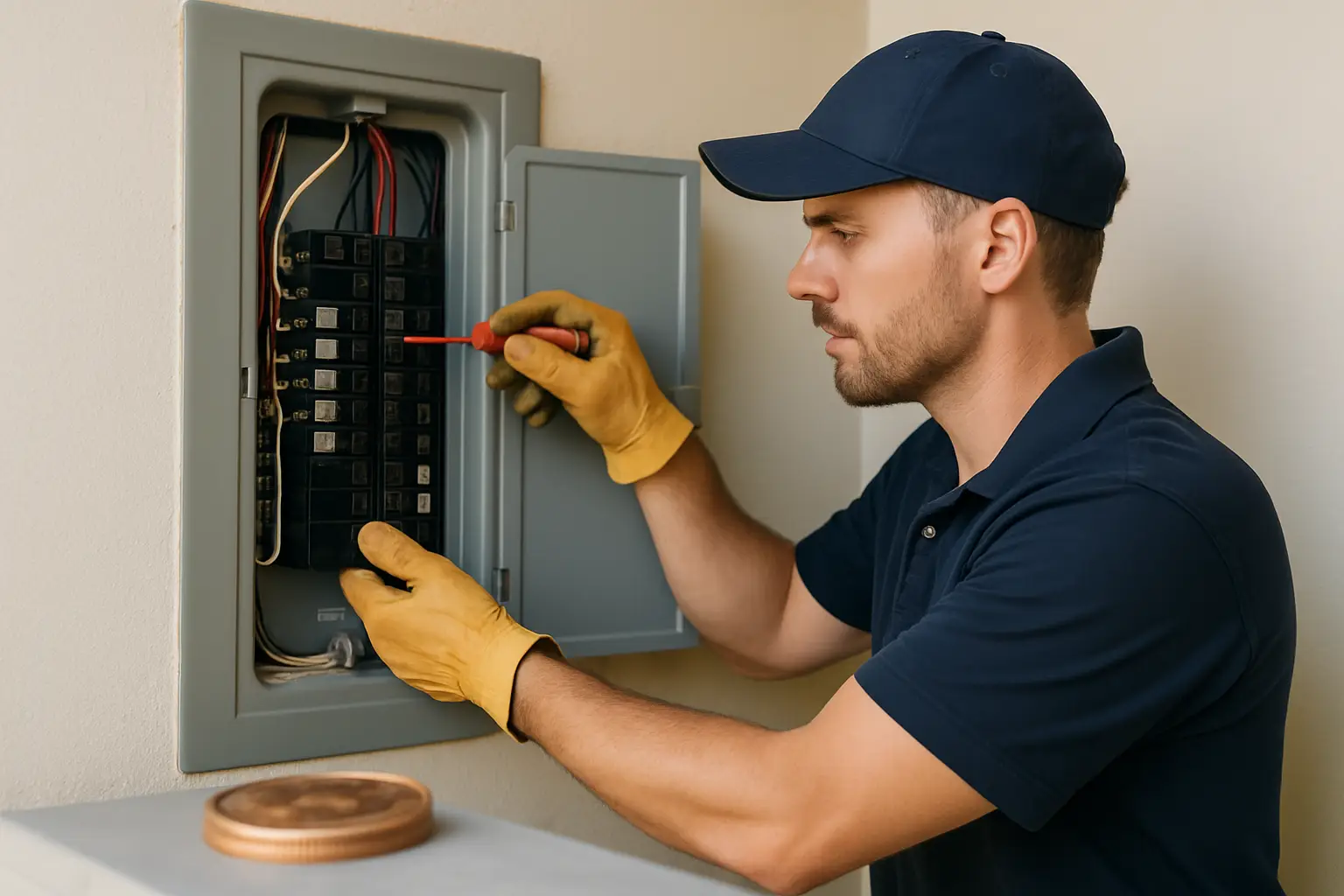
If your lights dim when the HVAC kicks on, breakers trip more than they should, or you are planning an EV charger, your electrical panel is probably the bottleneck. Homeowners around Bowling Green often start with a simple question: what does a panel upgrade cost? The honest answer is that there is a predictable range, but the final number depends on what your home already has, what you need it to safely support, and what has to be brought up to code during the upgrade.
What does a panel upgrade cost in real life?
Most panel upgrades land in a broad range because “panel upgrade” can mean a few different scopes of work. In many Kentucky homes, a straightforward replacement of an older panel with a modern 200-amp panel, using the existing service size and existing meter setup when possible, commonly falls in the $2,000 to $4,500 range.
When the project involves a true service upgrade (for example, changing from 100 amps to 200 amps), replacing or relocating the meter base, updating the service mast, or dealing with utility requirements, the cost often moves into $3,500 to $7,500+ territory. Some projects can go higher if there is extensive rewiring needed, difficult access, or complications such as damaged service conductors, old aluminum branch wiring issues, or a panel location that cannot remain where it is.
That spread is not contractors being vague. It reflects the reality that two homes on the same street can have very different electrical infrastructure behind the cover.
Panel changeout vs. service upgrade: the difference matters
A lot of cost confusion comes from mixing up two jobs.
A panel changeout is replacing the existing breaker panel with a new one of the same service size, typically keeping the meter and service conductors as-is if they are in good condition and sized correctly.
A service upgrade increases capacity, usually from 60 amps or 100 amps up to 150 or 200 amps. That can require changes outside the house, coordination with the utility, new service entrance conductors, and sometimes a new meter base or disconnect.
If your home already has adequate service size and the issue is simply an outdated or damaged panel, you may be closer to the lower end of the range. If you are adding major loads and the service is undersized, expect the upgrade to be more involved.
The biggest factors that change your total cost
The panel itself is not what makes the price swing. Labor, code requirements, and what has to be rebuilt to make the system safe and compliant are usually the drivers.
Your existing amperage and load needs
If your home is currently 100 amps and you want to support an EV charger, a hot tub, a heat pump, an electric range, or a future generator connection, 200 amps is a common target. Moving up in amperage can trigger additional work at the meter and service entrance, which adds time and material.
There is also a practical trade-off here: paying for more capacity than you need can be wasteful, but trying to “get by” on an undersized service often leads to nuisance tripping, limited options for upgrades, and repeated service calls. A professional load calculation brings this into focus quickly.
Panel location and accessibility
A panel that is easy to reach, properly mounted, and already in a code-acceptable location is usually faster to replace. When the existing panel is in a tight closet, a bathroom-adjacent space, behind shelves, or in a place that no longer meets clearance rules, relocation can become part of the project.
Relocating a panel can be worth it for safety and future serviceability, but it adds cost because circuits must be extended, rerouted, or reworked to reach the new location.
Number and condition of circuits
More circuits generally means more labeling, more terminations, and more time. If the wiring is neat and in good shape, the work is straightforward. If the existing panel has double-tapped breakers, mixed wire sizes on breakers, melted insulation, corrosion, or years of “DIY additions,” the electrician has to correct those issues as part of delivering a safe panel.
Sometimes homeowners discover their panel is full not because they need more power, but because the spaces are poorly used. Adding a subpanel or reorganizing circuits can be an option, but it still has to be done cleanly and to code.
Grounding and bonding upgrades
Modern code requirements for grounding and bonding are there for a reason: they help clear faults safely and reduce shock risk. If your current system lacks a proper grounding electrode, has undersized grounding conductors, or has bonding problems around water piping or other metal systems, those items may need to be brought up to standard during the upgrade.
This is one of those “hidden” costs that is actually a value add. You are not just buying a new metal box with breakers. You are buying a safer system.
Meter base, service mast, and weatherhead condition
If your service equipment outside is damaged, undersized, or outdated, it can force the project into a wider scope. A deteriorated mast, loose meter base, or compromised conduit is not something a professional electrician should ignore just to keep the bid low.
Permits and inspections
A properly done upgrade typically requires permits and inspection. That process protects you as the owner because it confirms the work meets code and is documented. Costs vary by jurisdiction, but it is normal for permit and inspection requirements to be part of the job.
Utility coordination and outage time
Some upgrades require the utility to disconnect and reconnect power. Scheduling and coordination can affect labor planning. Most homeowners care less about the administrative side and more about the reality: you will have a period without power on upgrade day. A good contractor plans that outage window carefully and communicates it clearly.
Common price scenarios homeowners ask about
Here is how costs typically shake out in the situations we see most.
A 100-amp to 200-amp upgrade for a growing household is often priced higher than a simple panel swap because the service entrance components may need to be replaced or resized. If your long-term plan includes an EV charger, finishing a basement, or adding a hot tub, doing the service upgrade now can be cheaper than trying to patch around capacity limits later.
A panel replacement due to safety concerns (burnt bussing, water intrusion, corrosion, hot breakers) may be closer to a mid-range cost if the service size can remain the same, but it can rise quickly if the damage extends into feeders or service conductors.
A panel upgrade to support a generator or transfer switch may involve adding a properly installed interlock or transfer equipment, labeling, and load management. This can be cost-effective compared to rewiring critical circuits one by one, but it needs to be planned so the system is safe and clear for anyone servicing it in the future.
Why the cheapest quote is not always the best deal
Electrical panels are not the place to bargain-hunt. If a quote is dramatically lower than others, ask what is not included.
Sometimes low pricing means no permit, no inspection, no grounding work, no labeling, reused questionable breakers, or “we will make it fit” shortcuts. The trade-off is risk – and that risk can show up as failed inspections, insurance headaches, unreliable performance, or, worst case, a safety incident.
A professional, reliable contractor will be transparent about what is included, what could change once the panel is opened, and what code upgrades are required to complete the job correctly.
How to keep your panel upgrade cost under control
You cannot control every variable, but you can avoid surprises.
Start by being clear about your near-future electrical plans. If you will add an EV charger next year, say it now. If you are thinking about a hot tub, sauna, pool equipment, or an addition, bring it up. An upgrade sized for today but not tomorrow can become a repeat expense.
Also, do not ignore warning signs leading up to the project. Chronic tripping, warm breaker handles, buzzing, scorch marks, or a burning smell should be treated as urgent. Waiting can turn a planned upgrade into an emergency repair.
Finally, ask for a quote that spells out the scope in plain language – service size, panel type, grounding and bonding work, permit handling, labeling, and what happens if hidden issues are found. Clear scope is what protects your budget.
Do you actually need a panel upgrade?
Sometimes the best answer is “not yet,” and that is fine. If the panel is in good condition and the service size is adequate, you may be able to add capacity with a subpanel, reorganize circuits, or correct specific issues without a full replacement.
On the other hand, if your panel is obsolete, damaged, overloaded, or full of unsafe modifications, upgrading is less about convenience and more about protecting the home and everyone in it. This comes up often in older properties, rental units, and small commercial spaces where the electrical system has been stretched over time.
Getting a local, code-compliant quote in Bowling Green
Panel work is always specific to the property. The fastest way to get a dependable number is an on-site evaluation where the electrician can see the service size, meter setup, panel condition, circuit count, and grounding. If you are in Bowling Green or nearby counties and want a professional, reliable quote, you can reach out to M Power Electric LLC and get clear guidance on the best path for your home or business.
A panel upgrade is not just a line item – it is the foundation that everything else plugs into, from your HVAC to your EV charger to the lights you expect to work every time you flip the switch. If you are on the fence, the most helpful next step is simple: plan for the power you want to use, then build the service to match it safely.