

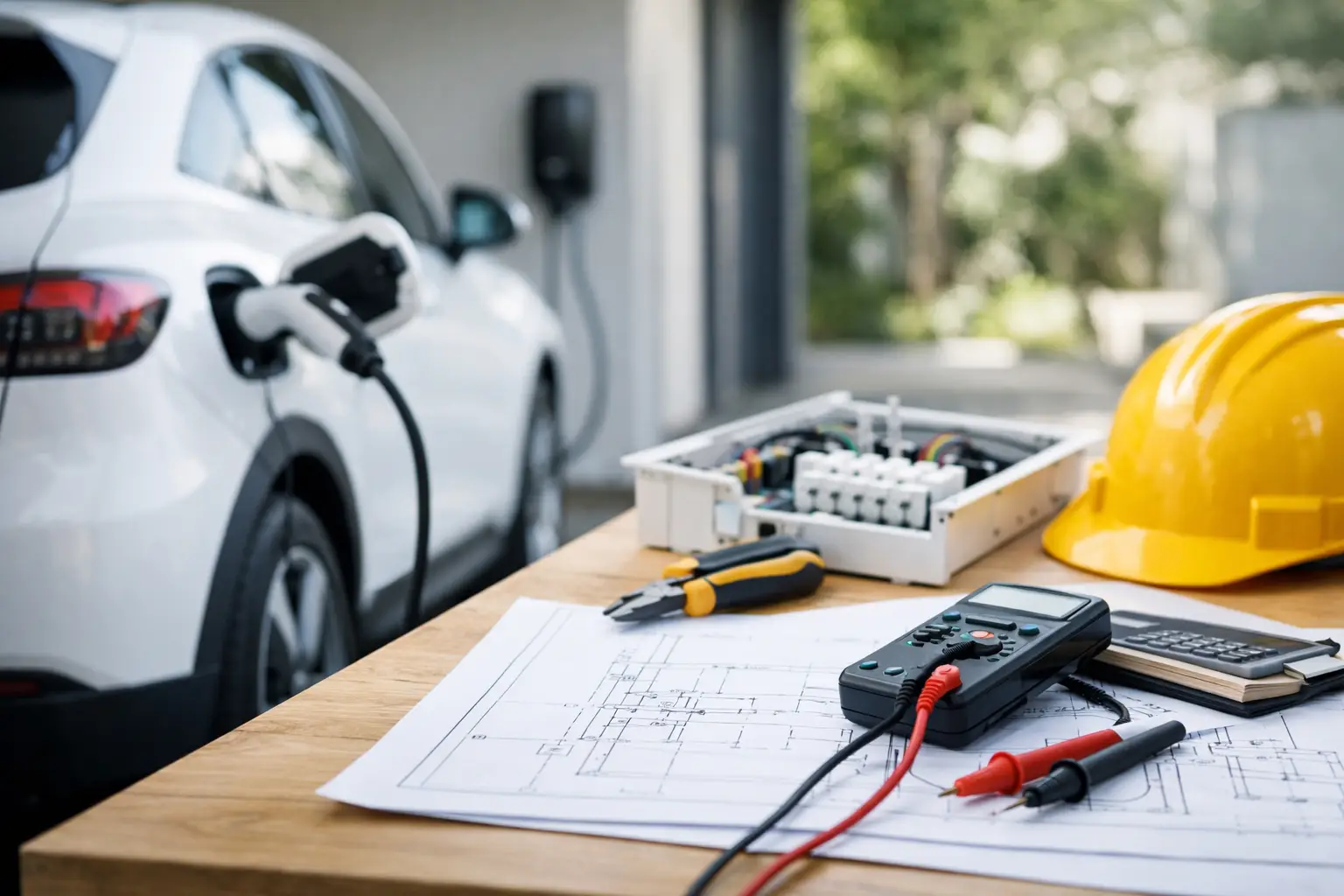
A Level 2 charger looks simple on the wall. The part most homeowners do not see is the math behind whether your panel can safely carry it. That is where an ev charger installation load calculation example helps. Before any charger goes in, the electrician needs to confirm your existing electrical service can handle the added demand without overloading the system.
For homeowners and property managers, this matters because EV charging is not a small plug-in load. A typical Level 2 charger can add a steady 32 to 48 amps for hours at a time. In some homes, that fits fine. In others, the charger is what exposes a panel that is already close to its limit.
What a load calculation actually checks
A load calculation is the process of estimating how much electrical demand a home or building places on the service. It is used to see whether the service, panel, and connected equipment can support a new load such as an EV charger.
This is not just a rough guess based on panel size. A 200-amp panel does not automatically mean there is plenty of room, and a 100-amp service does not automatically mean an EV charger is impossible. The answer depends on square footage, fixed appliances, heating and cooling equipment, electric water heating, cooking equipment, dryers, and other major loads already in the property.
The key point is simple. The breaker space might be available, but the total service capacity may still be too tight. That is why professional and reliable electricians calculate first and install second.
EV charger installation load calculation example for a home
Let’s use a straightforward example based on a single-family home with a 200-amp, 240-volt service. The homeowner wants a 40-amp EV charger circuit for a charger that delivers 32 amps continuously.
Because EV charging is considered a continuous load, the circuit has to be sized at 125 percent of the charging load. So if the charger delivers 32 amps, the circuit must be rated for at least 40 amps. That is why many residential chargers are installed on 40-amp or 50-amp circuits depending on the charger and vehicle setup.
Now assume this home has:
- 2,000 square feet
- Electric range
- Electric dryer
- Electric water heater
- Central air conditioning
- Gas furnace
- Standard lighting and receptacle loads
A simplified residential calculation might start with the general lighting load based on square footage. Using 3 volt-amps per square foot, 2,000 square feet gives 6,000 VA. Then small appliance and laundry loads are added. Two small-appliance circuits at 1,500 VA each plus one laundry circuit at 1,500 VA brings that section to 10,500 VA.
Under standard dwelling calculation methods, demand factors are then applied. The first 10,000 VA is counted at 100 percent, and the remainder at 40 percent. In this example, only 500 VA is above 10,000, so that adds 200 VA. That gives 10,200 VA for that portion of the load.
Next, add the fixed appliances. Let’s say the electric water heater is 4,500 VA, the dryer is 5,000 VA, and the range is 8,000 VA under the applicable demand method. Air conditioning might add another 3,500 VA. Add those to the 10,200 VA and the total becomes 31,200 VA.
Now add the EV charger. A 32-amp charger at 240 volts equals 7,680 VA. That brings the total calculated load to 38,880 VA.
To convert that to amps on a 240-volt service, divide by 240. The result is 162 amps.
On paper, that appears to fit within a 200-amp service. In that situation, the home may be a good candidate for the charger without a full service upgrade. But this is where experience matters. The exact calculation method, equipment ratings, demand allowances, and any optional calculation rules all affect the final answer.
Why two homes with the same panel can get different answers
This is where many online estimates fall short. Two homes may both have 200-amp panels, but one can accept a new EV charger with no issue while the other may need load management equipment or a panel upgrade.
A house with gas heat, gas water heating, and gas cooking usually leaves more electrical capacity available. A house with electric heat strips, a large range, a dryer, a hot tub, and a pool pump can be a very different story. The same goes for additions, workshops, detached garages, or rental units served from the same electrical system.
It also depends on the charger size. A 20-amp or 30-amp charging setup may fit where a 60-amp circuit does not. If a homeowner drives moderate daily miles, slower overnight charging may be the smarter and more cost-effective choice.
When a panel upgrade may be needed
If the calculated demand exceeds service capacity, the electrician has to look at practical options. Sometimes the solution is a smaller charger circuit. Sometimes it is an energy management system that adjusts charging when other loads are active. And sometimes the right answer is a panel or service upgrade.
A panel upgrade is often needed when the home already has a 100-amp service with several large electric loads. It can also come up when the existing panel is full, outdated, or has brand-specific safety concerns. In those cases, adding a charger is not just about convenience. It becomes part of bringing the electrical system up to current needs.
For property owners, this is usually the better long-term move if more electric appliances are coming later. A new EV charger, a future heat pump, and an electric water heater can add up quickly.
A closer look at continuous load and breaker sizing
One of the most important parts of any ev charger installation load calculation example is understanding continuous load rules. EV charging often runs for more than three hours, which means the circuit cannot be sized the same way as a short-term load.
Here is the practical version. If the charger will draw 40 amps continuously, the circuit must be rated for 50 amps. If it will draw 48 amps continuously, the circuit generally needs to be 60 amps. That affects not only the breaker, but also conductor sizing, equipment rating, and whether the panel has enough capacity for that branch circuit.
This is one reason DIY planning often misses the mark. People shop for the charger first and only later learn that the electrical system may not support their preferred amperage.
What homeowners should have ready before calling
If you are planning an EV charger installation, a few details help speed up the process. The charger make and model matters. So does the desired charging speed, the location of the panel, and where the charger will be mounted.
It also helps to know your service size if you have it available, along with major electric appliances in the home. That does not replace a professional load calculation, but it gives the electrician a stronger starting point. For many homes, the job is straightforward. For others, the right plan only becomes clear after a panel review and on-site assessment.
Why this is worth doing the right way
An EV charger is one of the few loads in a home that can pull significant power on a regular schedule for years. If it is installed on a system with marginal capacity, the problems can show up as nuisance breaker trips, overheating concerns, or limitations on future upgrades.
A professional and reliable installation starts with the numbers, not with assumptions. That is especially true for older homes, remodeled properties, and buildings that already support extra loads like hot tubs, workshops, or backup power equipment.
At M Power Electric LLC, we see this as part of doing the job correctly from the start. A charger should be convenient, safe, and code-compliant, and that only happens when the service is properly evaluated before installation begins.
If you are thinking about adding a home EV charger, the best next step is simple. Have a trained electrician check the panel, run the load calculation, and tell you what your property can realistically support. That gives you a clear answer before you spend money on the wrong equipment.