

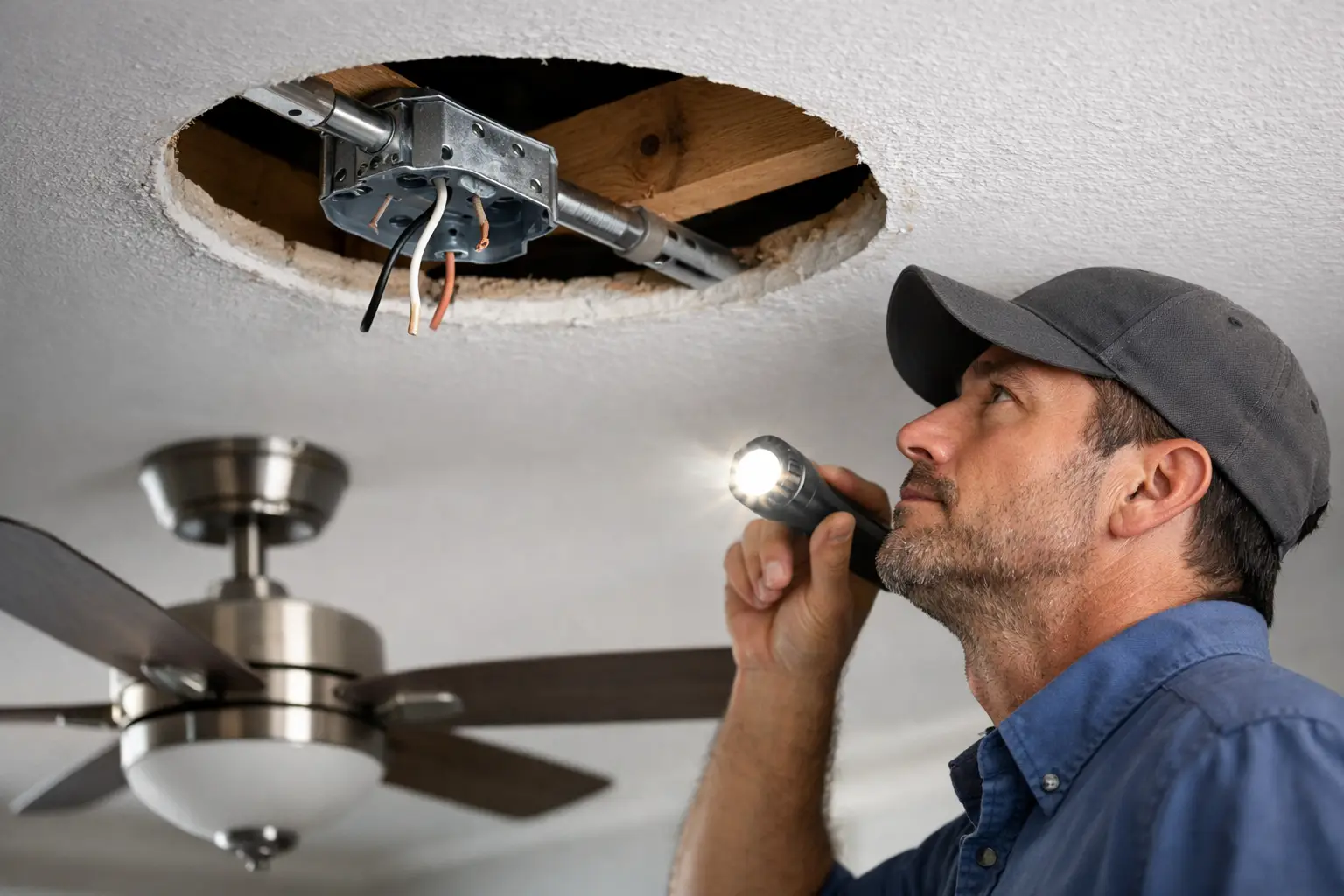
A ceiling fan that wobbles, hums, or pulls away from the ceiling is more than an annoyance. It can be a sign that the fixture is attached to hardware never designed to carry its weight and motion. So, do ceiling fans need bracing? In many installations, yes. At minimum, a ceiling fan needs a properly rated electrical box and secure structural support. Whether that means a separate brace depends on what is already above the ceiling.
Do Ceiling Fans Need Bracing in Every Home?
Not every ceiling fan needs an added brace, but every ceiling fan needs a support method approved for a ceiling-suspended fan. A standard plastic, shallow, or light-fixture-only electrical box is not enough. Those boxes may hold a lightweight light fixture, but they are not built for the downward load, vibration, and rotating force created by a fan.
If a fan-rated box is fastened directly to a solid framing member, such as a ceiling joist, an additional expandable brace may not be necessary. The joist itself provides the structural support. The box and fasteners still need to be listed and installed for fan use.
If the fan is located between joists, a fan brace is often the right answer. This adjustable metal support spans between framing members and gives the fan-rated box a solid mounting point. It is commonly installed through the existing ceiling opening, which can avoid opening a large section of drywall.
The real question is not whether every fan gets the same brace. The question is whether the fan is secured to framing with hardware rated for that job.
Why a Regular Ceiling Box Is Not Enough
A ceiling fan does not simply hang in place. As the blades turn, the motor creates movement and vibration. Even a well-balanced fan puts repeated stress on the box, mounting screws, and surrounding framing. Over time, hardware that was only intended for a light fixture can loosen or fail.
A fan-rated box is designed to handle that load. It should be clearly marked as acceptable for supporting a ceiling fan. The installation instructions for the fan and box matter as well, especially for larger fans, heavy decorative models, and fans with light kits.
Weight is only one part of the issue. A fan can be relatively light and still create trouble if its support moves. That is why a fan that shakes at high speed should never be ignored as a purely cosmetic problem. Blade imbalance may be part of it, but loose mounting hardware or an improperly supported box must be ruled out first.
When a Fan Brace Is Usually Needed
A brace is commonly needed when an existing light fixture is being replaced with a ceiling fan and the current box is mounted between joists. This is especially common in older homes, where the original box may be attached to a thin metal bar, drywall, or a support setup intended only for a light.
You may also need a brace when there is no accessible joist where you want the fan. For example, a fan centered in a room or over a seating area may fall between framing members. Rather than moving the fan location, an electrician can install a properly rated brace between the joists.
A brace may also make sense during remodeling when the ceiling cavity is open. In that situation, there may be several approved support options, including a new fan-rated box attached to blocking installed between joists. The best option depends on the framing layout, the fan weight, and access above the ceiling.
For vaulted ceilings, sloped ceilings, and rooms with limited attic access, the support issue can be more involved. The fan must be mounted to an approved support point, and the downrod, canopy, and mounting bracket must be compatible with the ceiling angle. A fan brace is not a one-size-fits-all fix for every ceiling type.
Signs Your Existing Fan Support Needs Attention
You cannot always confirm proper support by looking at the fan from below, but certain warning signs call for a closer inspection. A fan that visibly wobbles after the blades have been cleaned and balanced deserves attention. So does a canopy that sits loose against the ceiling, mounting screws that will not stay tight, or a clicking sound near the motor mount.
Other concerns include a fan installed on a very old ceiling box, a fan that replaced a light fixture without any box upgrade, or a fixture that shifts when gently touched. Do not pull hard on the fan to test it. That can make a weak installation worse. Turn off power at the breaker and have the mounting hardware inspected.
A fan may also seem stable at low speed and become unsteady at higher settings. That does not automatically prove the brace is missing, since warped blades or an unbalanced blade set can cause vibration. But it is a good reason to verify the structural support before relying on a balancing kit.
What Proper Ceiling Fan Support Looks Like
A sound installation starts with a fan-rated electrical box. That box must be securely connected to a ceiling joist, approved blocking, or a listed fan brace. The fan’s mounting bracket attaches to the box, and the fan itself attaches to the bracket according to the manufacturer’s instructions.
The wiring also has to be handled correctly. The box needs enough room for the conductors and connections, the grounding path must be continuous, and the circuit must be appropriate for the fan and any attached light kit. If a wall control is being added, the wiring arrangement may need to change as well.
In a newer home, there may already be a fan-rated box in place. The marking may be visible inside the box once the existing fixture is removed. In an older home, it is safer not to assume. Many older boxes look sturdy from below but are not rated for fan support.
Local code requirements and manufacturer instructions can affect the final installation. For heavy fans or specialty mounts, the fan’s listed support requirements take priority. An electrician can inspect the framing and existing box, then choose a support method that fits the ceiling rather than forcing a standard solution.
Can You Install a Ceiling Fan Without Going Into the Attic?
Often, yes. A retrofit fan brace can usually be installed from below through the existing electrical box opening. The old box is removed, the brace is placed through the opening and expanded between the joists, and a new fan-rated box is secured to the brace.
That said, access from below is not always simple. Tight ceiling cavities, unusual framing, plaster ceilings, damaged drywall, or existing wiring can complicate the work. If there is an attic above the room, access may make the installation easier, but it is not always required.
The goal is not to avoid opening drywall at all costs. The goal is to create a safe, durable support point with the least disruption practical. If the framing cannot be properly reached or the ceiling has hidden damage, a small repair may be the better choice than relying on a questionable mount.
Ceiling Fan Bracing Is Not a Place to Cut Corners
Ceiling fan installation looks straightforward until the mounting point is exposed. The fan may have only a few wires and screws, but its support system has to carry a moving load for years. Using a light-fixture box, drywall anchors, or improvised hardware is not a safe substitute for a fan-rated installation.
This matters for landlords and property owners as much as homeowners. A loose fan can damage the ceiling, wiring, furnishings, or someone standing below it. A properly installed fan also runs quieter and is less likely to develop recurring wobble problems.
M Power Electric LLC can inspect an existing fan location, replace an inadequate box, install a rated brace when needed, and wire the fan controls correctly. That is particularly helpful when upgrading an older home or adding fans where no previous fixture existed.
If you are replacing a light with a ceiling fan, treat the electrical box as part of the project, not an afterthought. A quick inspection before the fan goes up is the simplest way to make sure the finished installation stays secure, quiet, and ready for daily use.