

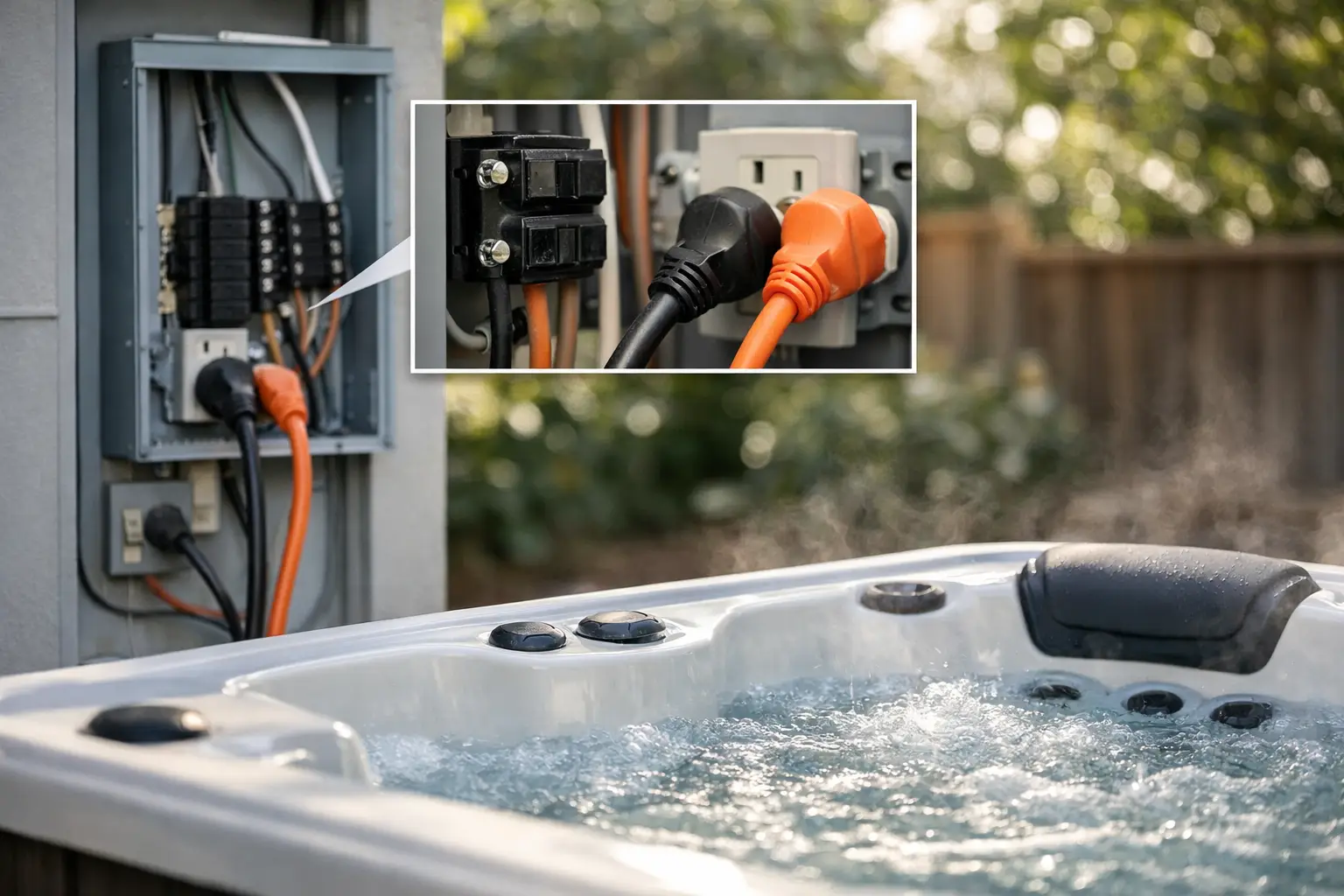
If you’re asking can hot tubs share circuit, you’re usually already seeing the bigger issue – a hot tub pulls serious power, and guessing wrong can trip breakers, damage equipment, or create a real safety hazard. This is not a plug-it-in-and-hope situation. Hot tubs sit outside, deal with water, heaters, pumps, and GFCI protection, and they need wiring that matches the load.
Most of the time, the practical answer is no. A hot tub should be on its own dedicated circuit. There are a few situations where people ask about sharing a circuit with another load, a subpanel, or even a second spa, but once you look at the amperage, manufacturer instructions, and code requirements, sharing usually stops making sense fast.
Can hot tubs share circuit with other equipment?
In most residential setups, no. A hot tub is commonly designed to run on a dedicated 240-volt circuit, often 40, 50, or 60 amps depending on the model. That circuit is sized for the tub’s pump motors, heater, control system, and startup demand. If you try to share that circuit with another appliance or outdoor load, you can exceed the breaker rating or create nuisance trips.
That matters because a hot tub is not a light-duty load. The heater alone can draw a large portion of the circuit capacity. Add pumps, blowers, or lighting, and the electrical demand climbs quickly. Even when the tub does not use every component at full draw all the time, the circuit still has to be built for the maximum conditions the equipment is designed to operate under.
There’s also the manufacturer’s instructions to consider. Many hot tubs specifically require a dedicated branch circuit. If the installation instructions call for that, that is the standard the installation needs to meet. Ignoring it is not just a bad idea for performance – it can affect safety, inspection approval, and even warranty coverage.
Why a dedicated circuit is usually required
A dedicated circuit gives the hot tub a protected electrical path with no competing loads. That’s the cleanest and safest way to supply equipment that has high demand and outdoor exposure.
It also simplifies GFCI protection. Most hardwired hot tubs require GFCI protection, often through a spa disconnect or breaker setup designed for that exact application. Once other loads get mixed into the same circuit, things become more complicated than they need to be. Troubleshooting gets harder. Tripping issues get harder to isolate. Service work gets messier.
For most homeowners, the question is not whether sharing is technically possible in some narrow scenario. The real question is whether it is smart, safe, and likely to pass inspection. In most cases, the answer points right back to a dedicated line.
What about two hot tubs on one circuit?
This is where the answer gets even more clear. Two hot tubs should not share one branch circuit unless there is a very specific engineered design that accounts for both loads, both disconnects, and all manufacturer requirements. That is not a standard residential setup.
Each hot tub has significant demand on its own. Putting two spas on one circuit can overload conductors, overrun breaker capacity, and create unreliable operation. Even if someone argues that both tubs will not run at full load at the same time, electrical installations are not supposed to be based on wishful thinking.
If a property has two hot tubs, or a hot tub and a sauna with significant electrical demand, the service needs to be evaluated properly. Sometimes the issue is not just the branch circuit. The main panel may also need more capacity, more spaces, or a subpanel installed in the right location.
Can a hot tub share a subpanel?
This is one area where people mix up terms. A hot tub can be fed from a subpanel, but that does not mean it shares a branch circuit.
A subpanel is simply a downstream distribution point. You might have a subpanel serving a patio area, pool equipment pad, detached structure, or addition. The hot tub can absolutely be one of the loads supplied from that subpanel if the panel is properly sized and installed. But the hot tub itself still typically needs its own dedicated breaker and wiring run.
That distinction matters. Sharing a panel is not the same as sharing a circuit. A properly planned subpanel can be a smart solution when the main panel is far away or already crowded. What you do not want is someone tapping the hot tub into an existing outdoor equipment circuit because it seems convenient.
Load calculations matter more than guesswork
When homeowners ask can hot tubs share circuit, the honest answer depends on real numbers, not rough estimates. You need to know the exact electrical requirements of the tub, the breaker size, the conductor size, the distance of the run, the available capacity in the panel, and what else is already on the system.
A 120-volt plug-and-play spa is different from a 240-volt hardwired hot tub. A smaller spa may draw far less than a full-size unit with multiple pumps and a large heater. But smaller does not automatically mean shareable. The manufacturer may still require a dedicated circuit, and outdoor wet-location equipment still calls for careful installation.
This is also where service capacity comes into play. If a home already has HVAC loads, kitchen loads, a dryer, water heater, and maybe an EV charger, adding a hot tub may push the panel closer to its limit than the homeowner realizes. The right move could be a panel upgrade, a subpanel, or a new dedicated circuit from the main service.
Common mistakes homeowners try to make work
A lot of bad hot tub wiring starts with a shortcut. Someone sees an existing 240-volt line nearby and wants to reuse it. Maybe it used to feed a welder, a disconnect for old equipment, or an unused appliance circuit. On paper that can look tempting. In reality, it has to match the hot tub’s exact requirements, protection needs, wire size, and installation instructions.
Another common mistake is assuming an outdoor receptacle circuit can handle more than it should. It cannot. Hot tubs are not patio lights or a small pump. They are major equipment loads in a wet environment.
Then there is the issue of do-it-yourself additions. A homeowner may think they are saving money by sharing a circuit or tying into an existing panel space without a proper evaluation. What they often end up with is tripping breakers, voltage drop, overheated wiring, failed inspections, or equipment that never runs the way it should.
When the answer is not an automatic no
There are cases where the setup can be designed around a broader distribution system, especially on larger properties or commercial sites. But even then, the hot tub itself is usually still on its own dedicated branch circuit. The flexibility is usually in how the property is fed, not in whether the spa shares wiring with random loads.
That is the trade-off homeowners need to understand. Yes, there may be a technical path in unusual circumstances. No, that does not make it the right answer for a typical backyard hot tub in Bowling Green. Most residential installs are safer, cleaner, and more reliable when the tub gets its own properly sized circuit, disconnect, and GFCI protection.
The safest way to plan a hot tub installation
Start with the hot tub’s nameplate and installation manual. That tells you the voltage, amperage, breaker requirement, and whether the manufacturer calls for a dedicated circuit. Then have the home’s electrical system evaluated to make sure the panel can support the added demand.
If the panel is full, undersized, or outdated, that should be addressed before the tub is connected. A proper installation may involve a panel upgrade, a new breaker, a spa disconnect, or a subpanel. That is normal. It is far better to handle those upgrades on the front end than to deal with a problem after the concrete pad is poured and the tub is already in place.
For homeowners and property owners, the bottom line is simple. A hot tub is a high-demand piece of equipment, and it deserves wiring that is built for the job. M Power Electric LLC handles this kind of work the right way – with clear load planning, safe installation, and no guesswork.
If you’re pricing a spa, renovating a patio, or trying to figure out whether your current service can handle one more major load, treat the electrical side like part of the project, not an afterthought. That is how you keep the hot tub running right and the rest of the property safe.