

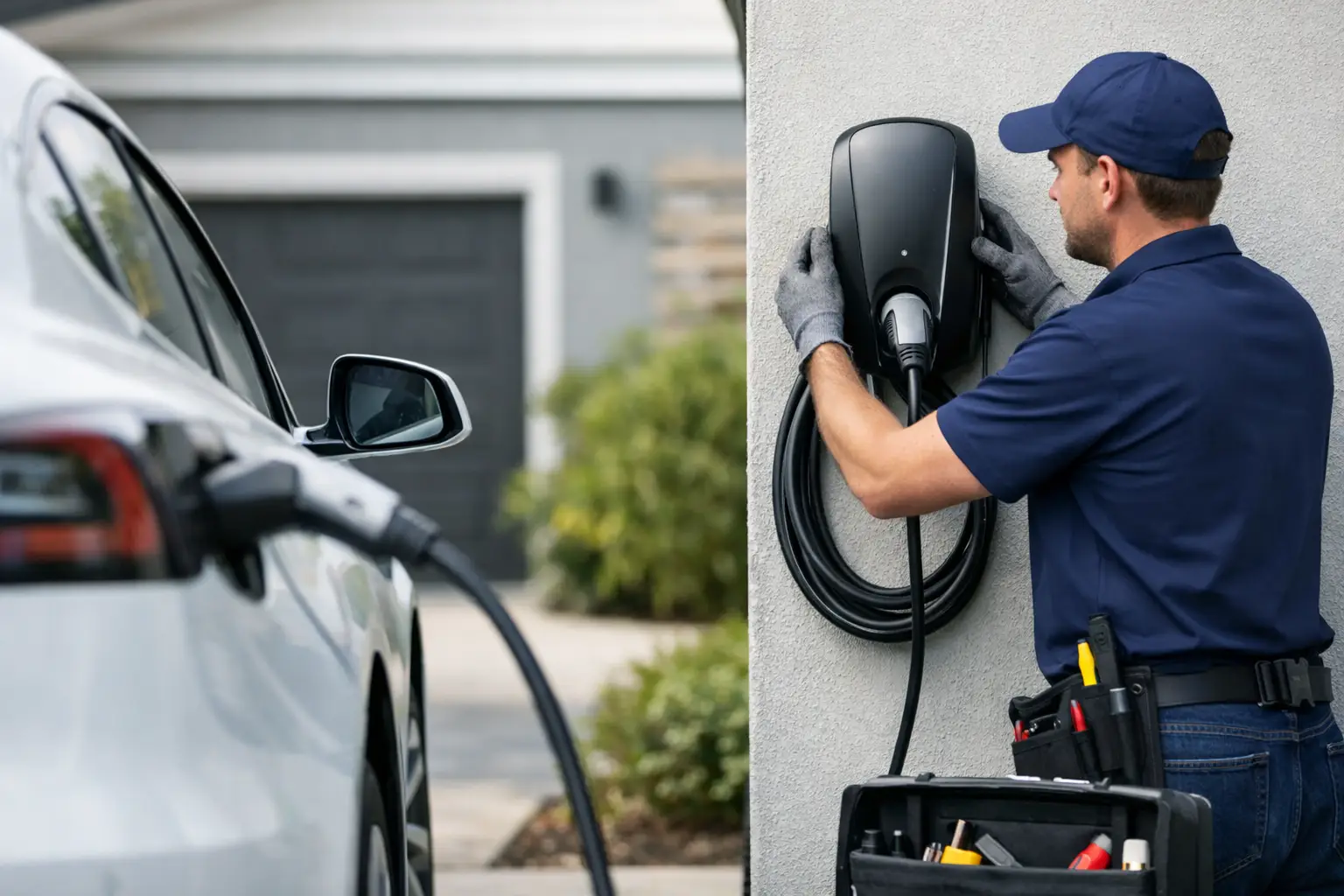
You usually find out fast whether your home is ready for an EV charger. Maybe the garage only has one general-purpose outlet. Maybe the panel is already full. Maybe you want faster charging than a standard wall plug can deliver. If you are looking up how to install EV charger equipment, the main thing to know is this: the charger itself is only part of the job. The real work is making sure your electrical system can support it safely.
For most homes, installing an EV charger is not a simple plug-and-play project. It often involves checking panel capacity, sizing a dedicated circuit, choosing the right charger location, and making sure the installation meets code. That is why homeowners in Bowling Green and surrounding areas usually get the best result when the job starts with a real electrical assessment instead of guesswork.
How to install EV charger equipment at home
The basic process sounds straightforward. Pick a charger, mount it, run power to it, and turn it on. In practice, each of those steps has electrical decisions behind it.
The first decision is the charging level you actually need. A Level 1 charger uses a standard 120-volt outlet, but it is slow. That may work if you drive short distances and charge overnight with plenty of time to spare. Most homeowners who install dedicated EV charging want Level 2 charging instead. A Level 2 charger runs on 240 volts and charges much faster, which is better for daily driving, households with more than one vehicle, or anyone who does not want to wait all day for a battery refill.
Once that is clear, the next step is checking whether your panel can handle the added load. This is where many installations either move ahead smoothly or turn into a panel upgrade discussion. An EV charger is a significant electrical load. If your service is older, undersized, or already supporting major appliances, HVAC equipment, a hot tub, or workshop circuits, there may not be enough capacity for another dedicated 240-volt circuit.
An electrician will usually perform a load calculation before anything gets installed. That determines what your system can safely carry and whether a new breaker and circuit can be added as-is. Sometimes the answer is yes. Sometimes a subpanel helps. Sometimes the main panel needs to be upgraded first. It depends on the age of the home, the service size, and what else is already running.
Picking the right location matters
Homeowners often focus on charger brand first, but placement matters just as much. The charger needs to be convenient for the vehicle, but also practical for wiring, weather exposure, and daily use. A garage wall near the parking position is common. For exterior installations, the equipment must be rated for outdoor use and mounted where the cord can reach without creating a hassle every time you plug in.
The farther the charger is from the electrical panel, the more labor and material may be involved. Long wire runs can increase cost and may also affect conductor sizing. If your ideal parking spot is on the opposite side of the house from the panel, that does not mean the job cannot be done. It just means the installation needs to be planned correctly.
Good placement also avoids future frustration. A charger mounted too high, too far from the vehicle port, or in a spot exposed to avoidable impact can turn a good investment into an everyday annoyance. A solid installation looks clean, works reliably, and feels easy to use.
Circuit size, breaker size, and charger output
This is the part where DIY articles usually oversimplify the job. Not every EV charger uses the same amperage, and not every home should be wired the same way.
Many residential Level 2 chargers are installed on 40-amp, 50-amp, or 60-amp circuits, depending on the charger’s rating and the vehicle owner’s goals. The breaker size, wire size, and actual charging output all need to match manufacturer instructions and electrical code requirements. Continuous loads like EV charging have specific rules, and that affects how the circuit is designed.
There is also a difference between a charger that plugs into a receptacle and one that is hardwired. A plug-in unit can be easier to replace later, but it still needs the correct outlet type and circuit. A hardwired charger can provide a cleaner, more permanent setup and is often preferred for higher-output units. Neither option should be treated casually. The details matter.
Why permits and code compliance are part of the job
If you are wondering how to install EV charger systems legally and safely, permits are part of the answer. A proper installation is not just about making it work. It is about making sure the work meets local code, protects your property, and does not create hidden hazards inside the walls or at the panel.
That matters for safety now and for your home later. If you sell the property, unpermitted electrical work can create headaches. If there is ever an insurance issue, undocumented or improper electrical changes can become a serious problem. A licensed electrician handles the installation with the right standards in mind, not just the shortest path to power.
In many cases, the work may also require GFCI protection, correct disconnecting means, proper mounting clearances, and equipment listed for the intended use. Those are not small details. They are what separate a safe installation from one that only looks finished.
What can go wrong with a DIY EV charger install
A lot of homeowners are comfortable with basic home projects. Replacing a light fixture or receptacle is one thing. Installing a dedicated 240-volt EV charging circuit is another.
The most common problems in DIY EV charger work are undersized wire, incorrect breaker selection, overloaded panels, poor terminations, and bad assumptions about service capacity. Sometimes the charger powers up and seems fine at first, but the real issue shows up later as nuisance tripping, overheating, voltage drop, or stress on the panel.
There is also the simple risk factor. You are working inside energized equipment or making modifications to circuits that carry serious current. A mistake here is not cosmetic. It can damage equipment, create fire risk, or put someone in harm’s way.
That is why this kind of project makes sense to hand over to a trained electrician. It protects the vehicle, the home, and the people using both.
When a panel upgrade becomes part of the installation
One of the biggest sticking points in EV charger projects is the electrical panel. Homeowners often plan for the charger cost and then get surprised when the panel becomes the bigger issue.
If your home has an older service, limited breaker space, or a panel that is already near capacity, adding EV charging may require more than one new circuit. In some homes, a panel upgrade is the cleanest long-term fix. That can also help if you are planning other electrical additions like a generator, electric water heater, hot tub, or workshop equipment.
This is not always bad news. A panel upgrade can improve safety, provide room for future expansion, and bring an older system up to current demands. It is an investment, but for many homes it is the right one.
Commercial EV charger installation has different needs
For commercial properties, the process is more involved. A business owner or property manager may need to think about multiple chargers, customer access, employee charging, parking layout, signage, and load demands across the building. The equipment selection may be different, and the service capacity questions are usually bigger.
In that setting, installation is less about adding one convenience feature and more about making the site function well. The charger needs to work with the property, not against it. That takes planning, especially if future expansion is likely.
What to expect from a professional installation
A professional EV charger installation usually starts with a site visit and electrical review. The electrician looks at the panel, available capacity, charger location, wiring path, and any code or access issues. From there, you get a clear recommendation based on your home or property, not a one-size-fits-all guess.
If the panel can support the charger, the installation may be straightforward. If upgrades are needed, you should know that upfront. Either way, the goal is the same: a safe, code-compliant charger that fits how you actually use your vehicle.
At M Power Electric LLC, that practical approach is exactly what local customers need. No runaround, no overcomplication, just skilled electrical work done the right way for homes and businesses in Bowling Green and nearby counties.
If you are thinking about EV charging, the smartest first step is not picking a charger off a shelf. It is making sure your electrical system is ready for one. Get that part right, and the rest of the project goes a whole lot smoother.