

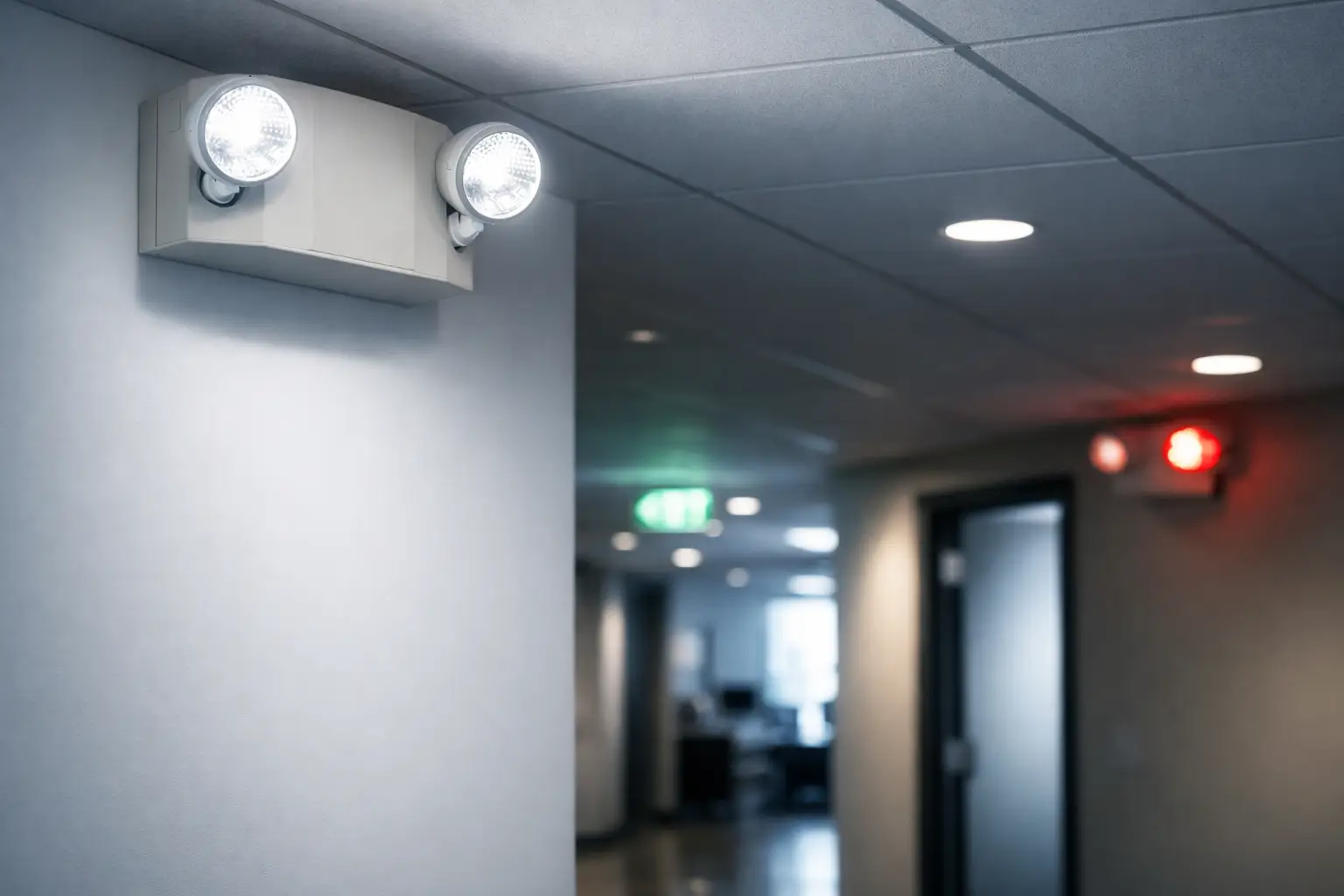
When the power drops in a commercial building, people do not stop moving. Employees still need a path out, customers still need to see where they are going, and managers still carry the responsibility for safety. That is why commercial emergency lighting is not a nice extra. It is a core part of keeping a property safe, code-compliant, and ready for the unexpected.
For business owners and property managers, this usually becomes urgent at the worst time – after a failed inspection, during a renovation, or after lights do not perform the way they should during a test. The better approach is to treat emergency lighting as part of the building’s everyday electrical system, not as an afterthought. When it is planned, installed, and maintained correctly, it supports safe egress, reduces liability, and helps your building function the way it is supposed to when normal power is gone.
What commercial emergency lighting is really for
Commercial emergency lighting is designed to provide illumination when normal power fails. In practical terms, that means lighting exit pathways, stairwells, hallways, and other critical areas long enough for occupants to leave the building safely. In many properties, it also works alongside illuminated exit signs so people can identify the nearest route out even in low visibility or complete darkness.
The point is not to keep your whole business running at full capacity. Emergency lighting is there to support life safety first. That distinction matters, because some owners expect these fixtures to work like backup lighting for normal operations. They do not. If you need operational continuity for equipment, registers, refrigeration, or security systems, that usually involves a broader backup power strategy such as a generator or other dedicated emergency power design.
Where emergency lighting matters most
In a small office, the layout may be simple enough that emergency fixtures cover a few key paths and exits. In a larger retail space, warehouse, church, restaurant, medical office, or multi-tenant property, the layout gets more complex fast. Corners, storage rooms, restrooms, long corridors, electrical rooms, and stairwells can all affect fixture placement.
That is where many problems start. A building may technically have emergency lights installed, but they are not always in the right places, not bright enough for the path of egress, or not supported by the right testing and battery backup setup. During an inspection or a real outage, those weak spots show up quickly.
Common types of commercial emergency lighting
There is no one-size-fits-all setup. The right system depends on the building use, occupancy, layout, and existing electrical infrastructure.
Battery backup emergency lights
These are common in many commercial spaces. The fixture includes a battery that charges during normal operation and switches on when power is lost. They are often used in hallways, near exits, and in utility areas. They are practical and cost-effective, but batteries do not last forever. If they are not tested and replaced when needed, the fixture may look fine on the wall and still fail when it counts.
Exit signs with battery backup
Exit signs are a major part of safe egress, and many include internal battery backup. These signs need to remain visible during a power outage and must be installed where occupants can clearly identify the path out. Poor placement, old lamps, or failed batteries can make an exit sign far less useful than it should be.
Remote head units and inverter-supported systems
Some commercial properties use centralized approaches where multiple fixtures or heads are supported through a larger backup source. These setups can make sense in bigger buildings or in properties with more demanding layout requirements. The trade-off is that design, wiring, and maintenance can be more involved.
Why code compliance is only part of the job
Most owners start thinking about emergency lighting because of code, and that makes sense. Life safety systems are heavily tied to inspection requirements. But code compliance alone should not be the finish line. A system can check a box on paper and still create headaches if it is poorly installed, hard to maintain, or not suited to the building.
A good emergency lighting plan has to account for real-world use. If a space is being remodeled, divided, expanded, or repurposed, the original fixture layout may no longer make sense. A new wall, a relocated doorway, or a converted storage area can change the path of egress enough to require updates.
That is why commercial emergency lighting should be reviewed any time your business changes the layout, updates occupancy, or takes on electrical upgrades. Waiting until a city inspection or fire marshal visit is usually the more expensive route.
Signs your emergency lighting needs attention
Some issues are obvious. A unit may beep, show a fault light, or fail a push-button test. Others are easier to miss. If your building has older fixtures, yellowed lenses, damaged housings, inconsistent illumination, or signs that batteries are no longer holding charge, it is time for a closer look.
Another common issue is mixed equipment from different eras of work. Over time, properties often collect patchwork electrical updates – one fixture added during a remodel, another replaced after damage, another installed to satisfy a prior inspection note. The result can be a system that works unevenly and is harder to service. A professional review helps bring that back into a more reliable condition.
Installation is not the place to cut corners
Emergency lighting may look simple, but proper installation takes more than mounting a fixture and connecting power. Fixture location, branch circuit planning, test function, charging behavior, and compatibility with the rest of the electrical system all matter. In occupied buildings, you also need to think about disruption, access, and how the work fits around daily operations.
There is also the issue of future service. Cheap fixtures and rushed installs can create repeat calls, nuisance failures, and inspection problems. The lowest upfront price is not always the lowest long-term cost. For many businesses, it makes more sense to install dependable equipment and know the system was put in correctly the first time.
Maintenance keeps the system from becoming a wall decoration
Emergency lighting is one of those systems people assume will work until the day it does not. Batteries age. Components fail. Building use changes. If nobody is checking the system, small failures turn into major liabilities.
Routine testing and maintenance help catch weak batteries, failed lamps, charging issues, and coverage gaps before an outage exposes them. For property managers, this is especially important in multi-tenant spaces where common area safety is part of your responsibility. For business owners, it is part of protecting staff, customers, and the operation itself.
If your building already has emergency lighting but you are not confident in its condition, a professional inspection is the smart next step. It is far better to find a problem during planned service than during an emergency.
Choosing the right electrician for commercial emergency lighting
This is not specialty work you want handled by guesswork. Commercial emergency lighting needs to be installed and serviced by electricians who understand life safety expectations, code-sensitive work, and the realities of commercial buildings. That includes knowing when a basic fixture replacement is enough and when the building needs a broader review of exits, circuits, or backup power support.
For businesses in Bowling Green and surrounding counties, working with a professional and reliable electrical contractor matters. M Power Electric LLC handles commercial electrical work with a practical, safety-first approach, helping property owners address lighting, power, upgrades, and code-related concerns without making the process harder than it needs to be.
When to schedule service
If you are opening a new location, renovating a space, managing an older building, or preparing for an inspection, now is the right time to look at your emergency lighting. The same goes for any property where fixtures have not been tested consistently or where outages have already exposed weak performance.
Good emergency lighting does a quiet job until the moment it matters most. When that moment comes, you do not want uncertainty. You want lights that come on, exits that are clear, and work that was done right the first time. If there is any doubt about your current setup, getting it checked now is the safer call.