

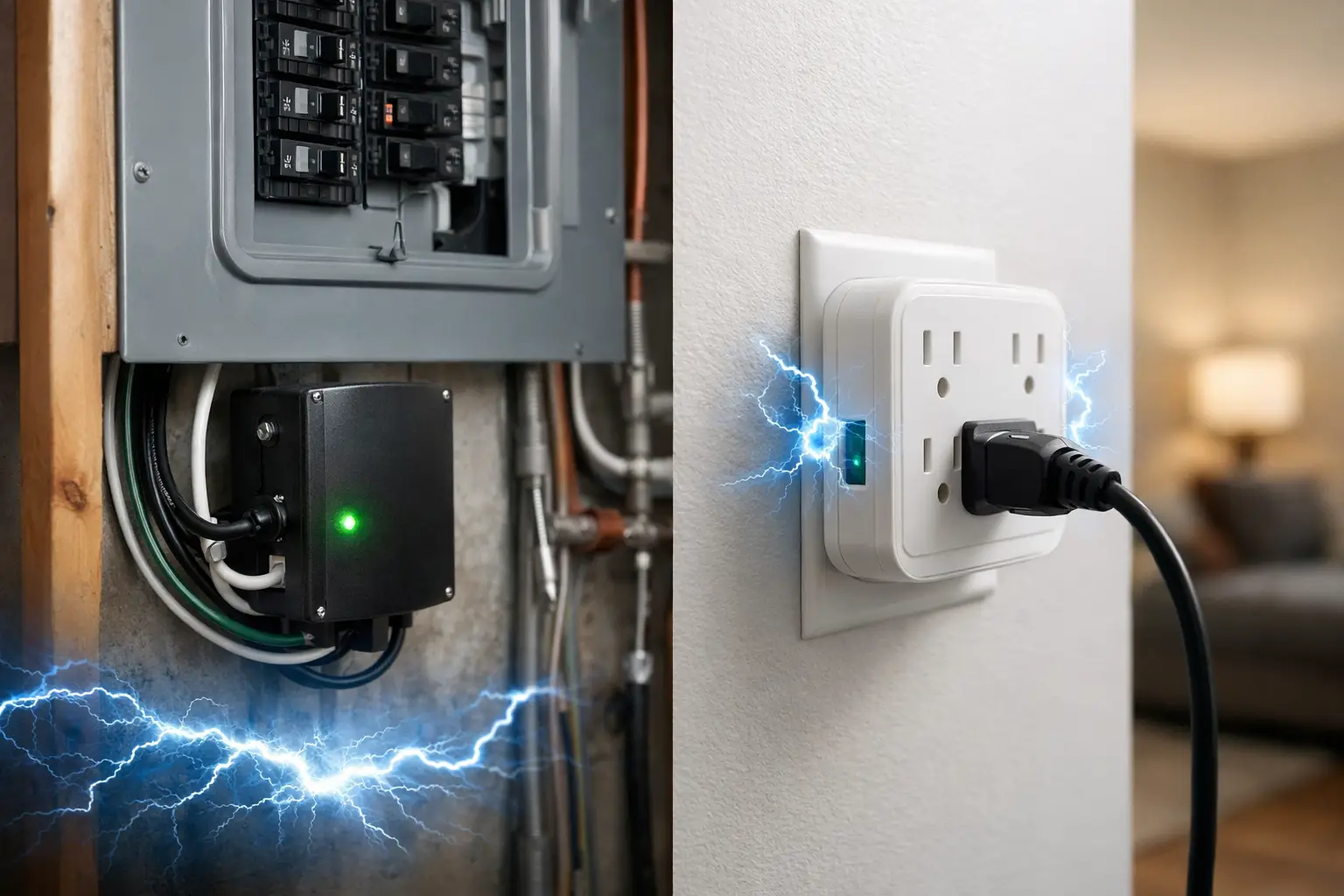
A lightning storm does not have to hit your house directly to damage electronics. One strong surge from the utility side, a large appliance cycling on, or a nearby strike can put expensive equipment at risk fast. When homeowners ask about whole home surge protector vs plug in options, the real question is usually this: what actually protects the things you paid for?
The short answer is that both types matter, but they do different jobs. A whole-home device is designed to stop larger surges at your electrical panel before they spread through the house. Plug-in protectors add a second layer at the outlet for TVs, computers, gaming systems, routers, and other sensitive equipment. If you only choose one without understanding the limits, you can end up with gaps in protection.
Whole home surge protector vs plug in: what is the difference?
A whole-home surge protector is installed at the electrical panel or service equipment. Its job is to intercept incoming voltage spikes and divert excess energy safely, reducing the amount of surge energy that reaches branch circuits. This is your first line of defense.
A plug-in surge protector works at the receptacle where electronics are connected. It helps protect individual devices from smaller leftover surges that make it past the panel, as well as certain surges created inside the home when motors and compressors switch on and off.
That difference matters because not all surges are the same. Large surges and repeated minor surges can both shorten the life of electronics, appliances, and smart home equipment. One type of protector does not fully replace the other.
What a whole-home surge protector does well
A whole-home surge protector protects more than just what you can see plugged into a strip. It can help protect major appliances and hardwired systems like your HVAC equipment, refrigerator, oven controls, garage door openers, washer and dryer electronics, and newer smart devices connected throughout the house.
This is especially useful in homes with expensive equipment spread across multiple rooms. If you have a tankless water heater, a variable-speed HVAC system, a generator connection, pool equipment, a hot tub, or an EV charger, you have more electronics and control boards than many homeowners realize. Those components can be sensitive to voltage spikes.
Another advantage is convenience. Once professionally installed, protection is working at the source rather than depending on you to remember which devices are plugged into what. For many property owners, that peace of mind is a big reason to install one.
But there is a limit. A whole-home surge protector does not guarantee that every spike is eliminated at the outlet. It reduces and redirects surge energy, but some residual voltage can still reach sensitive electronics. That is why panel protection is strong protection, not complete protection by itself.
Where plug-in surge protectors make sense
Plug-in surge protectors are useful because modern electronics are more delicate than many major appliances. A TV, desktop computer, modem, router, security system hub, gaming console, or home office setup can be affected by smaller fluctuations that might not damage a motor but can hurt circuit boards over time.
For that reason, plug-in protection still has value even in a house with panel-level surge protection. Think of it as point-of-use protection for your most sensitive and expensive electronics.
There is a catch, though. A basic power strip is not always a real surge protector. Many people assume they are protected because devices are plugged into a strip, but some strips only add extra outlets. Others have very limited protection and wear out over time. If a plug-in unit has taken multiple hits, it may not be performing as expected anymore.
Plug-in units also protect only what is plugged into them. They do nothing for hardwired equipment and do not stop a surge from traveling through the rest of the electrical system first.
Why many homes need both
For most homes, whole home surge protector vs plug in is not really an either-or decision. It is a layered protection decision.
The whole-home device handles the bigger job at the panel. Plug-in protectors handle the smaller job at the equipment. That combination is often the best practical setup because it addresses both major incoming surges and leftover voltage that can still affect sensitive electronics.
This is even more relevant in homes with updated technology. Smart thermostats, video doorbells, security cameras, internet equipment, Wi-Fi appliances, and charging stations all add convenience, but they also add components that can be damaged by unstable power. The more electronic controls you have, the more sense layered surge protection makes.
When a whole-home surge protector is the better priority
If your panel is older, your home has undergone upgrades, or you have invested in larger electrical equipment, a whole-home surge protector should usually be the first conversation. It becomes even more important if you have frequent outages, flickering, storm activity, or utility-related power events in your area.
It is also the better priority if your goal is broad protection. A plug-in strip cannot protect an HVAC system, range, dishwasher, pool equipment, or garage door opener. A panel-mounted protector can help reduce risk across the entire electrical system.
Homeowners in Kentucky also know weather can be unpredictable. Storm-related surges are one concern, but not the only one. Utility switching and internal load changes can also create damaging conditions. If your house has expensive systems connected all over the property, protecting at the panel is the smarter starting point.
When plug-in protection still deserves attention
If you work from home, have a media room, run a business from the property, or rely on internet-connected devices every day, plug-in protectors still matter. Losing a refrigerator control board is frustrating. Losing a computer, modem, router, and home office setup can stop your day immediately.
Point-of-use protection is also a practical answer when certain devices are especially valuable or especially sensitive. Even with a whole-home protector installed, it is reasonable to add quality surge protection for office equipment, entertainment systems, and network hardware.
This is where details matter. The wrong strip, a worn-out protector, or an overloaded setup is not a real plan. Good protection depends on proper product selection and safe installation practices.
Installation is not the place to guess
A whole-home surge protector connects directly to your electrical system, so installation should be handled by a professional and reliable electrician. Proper device selection depends on your panel, service configuration, grounding, and the type of equipment in the home or building. If there are underlying issues such as an outdated panel, poor grounding, or code problems, surge protection alone will not fix them.
That is why this topic often overlaps with larger electrical upgrades. If you are already planning a panel upgrade, generator work, EV charger installation, or electrical improvements for a pool or hot tub, it makes sense to ask about surge protection at the same time. It is often more efficient to evaluate the full system instead of adding protection in pieces without a plan.
For homeowners and business owners in Bowling Green and surrounding areas, M Power Electric LLC can help determine what level of protection fits your property and equipment. The goal is not to oversell a device. The goal is to protect what matters and make sure the electrical system supporting it is safe and code-compliant.
The trade-off homeowners should understand
If you install only plug-in protectors, you may leave major appliances and hardwired systems exposed. If you install only a whole-home protector, you may still leave sensitive electronics without enough local protection. The trade-off is not about which product sounds better. It is about where protection starts, where it ends, and what equipment you actually need to protect.
For some households, a whole-home surge protector is the bigger win because it covers more of the home. For others, especially those with valuable electronics or home office equipment, plug-in protection remains part of the answer. Most of the time, the best setup is both – installed and selected with the electrical system in mind.
If you are thinking about surge protection, the most helpful next step is simple: look at what would be expensive, disruptive, or hard to replace if a surge hit tomorrow, then protect that equipment from the panel all the way to the outlet.