

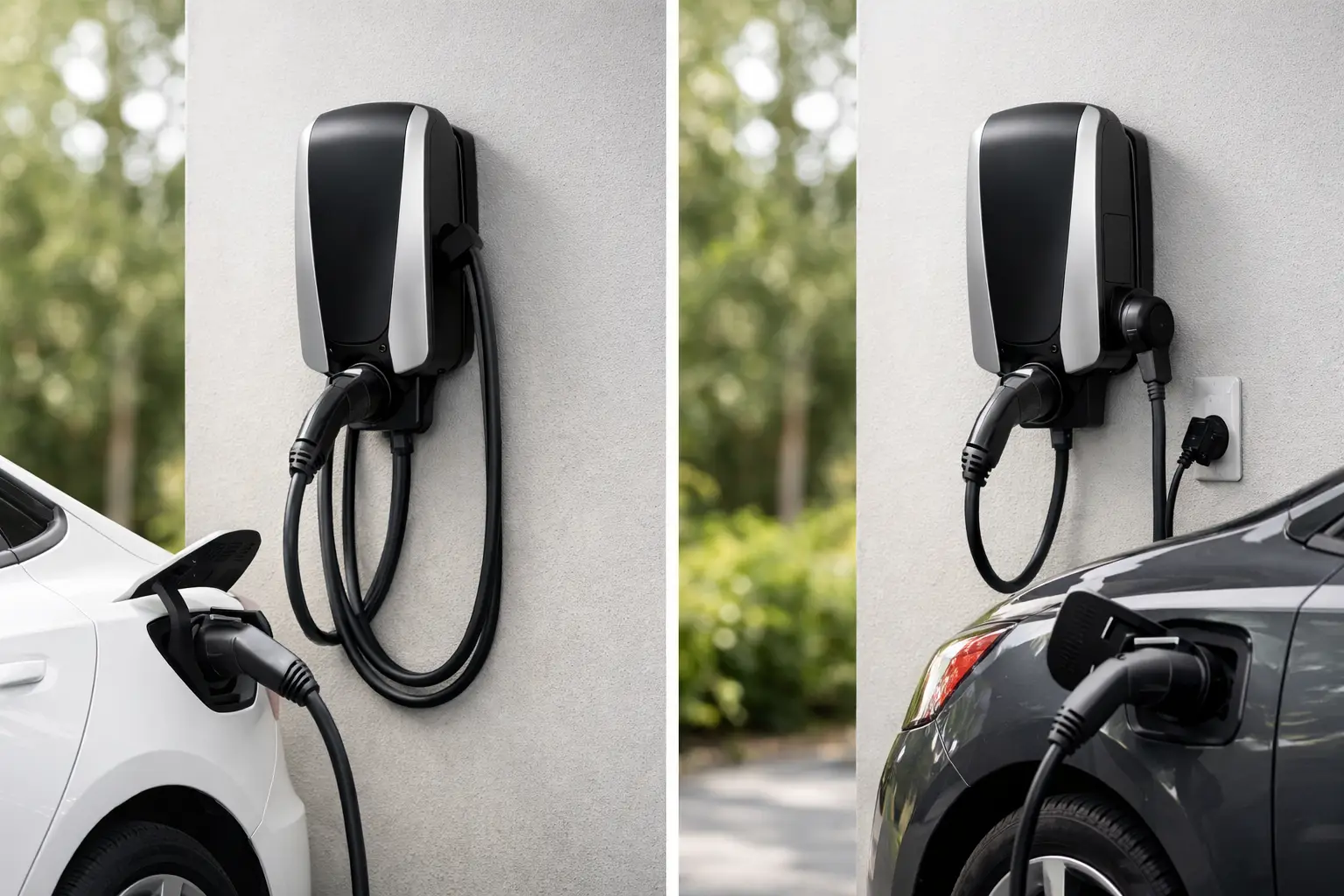
If you’re planning a home charging setup, the ev charger hardwired vs plug in comparison matters more than most people expect. On paper, both options charge your vehicle. In a real garage in Bowling Green, with an existing panel, daily use, and code requirements, the better choice depends on how you drive, how your electrical system is set up, and whether you want flexibility or a more permanent installation.
A lot of homeowners start by asking which one is cheaper. That is a fair question, but it is not the only one. Safety, breaker size, available capacity, outlet quality, and long-term reliability all matter just as much.
EV charger hardwired vs plug in comparison: the basic difference
A hardwired EV charger is connected directly into your electrical system with no receptacle involved. The wiring runs from the panel to the charger, and the unit is permanently installed by a qualified electrician.
A plug-in EV charger uses a 240-volt receptacle, usually a NEMA 14-50, and the charger plugs into that outlet. It is less permanent, which appeals to homeowners who may move, want the option to replace the charger easily, or already have a suitable outlet in place.
Both can be excellent options when installed correctly. The wrong setup usually happens when someone assumes an existing outlet is ready for EV charging or when the panel is close to maxed out and no one checks load capacity first.
Why hardwired chargers are often the better long-term choice
Hardwired chargers are usually the stronger option for homeowners who charge often and want a clean, dedicated setup. Because the charger is directly connected, there is one less point of failure. No plug, no receptacle, and less chance of heat buildup at the connection point.
That matters because EV charging is a high-demand, long-duration electrical load. This is not like plugging in a dryer for an hour once in a while. A charger may run for several hours at a time, multiple days a week. Over time, weak receptacles, loose connections, or lower-grade outlet installations can become a problem.
A hardwired charger can also support higher amperage in many cases. If you want faster Level 2 charging and your vehicle, panel, and charger support it, hardwiring often gives you more room to take advantage of that. Some charger manufacturers also require hardwiring for their highest output settings.
There is also the practical side. A hardwired unit looks more finished. It is typically mounted exactly where it needs to be, with wiring protected and routed correctly. For homeowners planning to stay in the house and use an EV for years, that permanence is usually a plus, not a drawback.
Where plug-in chargers make sense
A plug-in charger is not a second-rate option. In the right situation, it is a smart one.
If you already have a properly installed 240-volt outlet in the garage and it is on the right circuit, a plug-in charger can reduce installation work. If you move in a few years, you may be able to take the charger with you more easily. Some homeowners also like the ability to unplug and replace the unit without changing the fixed wiring.
Plug-in chargers can work well for moderate charging needs, especially if your commute is predictable and you are charging overnight rather than trying to recover a large battery quickly every evening. For some households, that flexibility is enough to tip the decision.
The catch is that the outlet has to be right. Not just present, but right. A worn, improperly installed, or lightly rated receptacle is not something you want carrying a repeated EV load. This is where professional installation matters. The charger may come in a box from the manufacturer, but the electrical system behind it has to be ready for the job.
Cost is not just about the charger
The ev charger hardwired vs plug in comparison often gets reduced to upfront price, but installation cost depends on more than the charger type.
If your panel has available capacity, the install location is close by, and no upgrades are needed, either option may be fairly straightforward. If the panel is full, undersized, or located far from the garage, cost can go up fast for both.
A plug-in setup may require a heavy-duty receptacle, a proper box, the correct breaker, and wiring sized for the load. A hardwired setup removes the receptacle cost but still requires the right breaker, wire size, disconnect considerations when required, and labor for a permanent installation.
Then there is the issue many homeowners do not see at first – panel capacity. If your home already has a busy electrical load with HVAC, water heater, kitchen equipment, or a hot tub, adding EV charging may require load calculations or a panel upgrade. That is why a cheap-looking option on day one can become the more expensive one once the real electrical work is evaluated.
Safety and code matter more than convenience
This is the part where shortcuts cause problems. EV charging is not a place for guesswork, adapter chains, or using an outlet that was “probably installed right” years ago.
Hardwired chargers generally reduce some common failure points because there is no cord cap and receptacle interface heating up under repeated use. That is a real advantage. But plug-in chargers can still be safe and code-compliant when the outlet, breaker, conductor size, and installation method are all correct.
Code requirements can also vary based on charger type, amperage, circuit design, and local enforcement. GFCI requirements, dedicated circuits, and manufacturer instructions all have to line up. If they do not, you can end up with nuisance tripping, poor charging performance, or a setup that needs to be redone.
For property managers and business owners, this matters even more. Liability changes the equation. A charger that is used regularly by tenants, employees, or customers needs to be installed with durability and safety in mind from the start.
Which option is better for your home?
For many homeowners, hardwired is the better choice if you want the most reliable setup, cleaner installation, and the option for higher charging output. It is especially strong for daily EV drivers, multi-EV households, and anyone planning to stay put.
Plug-in is a solid fit if you value flexibility, already have the right 240-volt receptacle setup, or want a charger you can more easily take with you later. It can also work well when charging demands are moderate and the installation is verified by a professional.
The real answer depends on four things: your panel capacity, charger location, driving habits, and future plans. A homeowner with a short commute and a newer garage circuit may be perfectly happy with plug-in. A homeowner adding a second EV, dealing with a crowded panel, or wanting maximum reliability will often be better served by hardwiring.
Before you choose, check the system behind the charger
The charger itself gets most of the attention, but the panel and branch circuit do the heavy lifting. Before choosing between hardwired and plug-in, it makes sense to have an electrician check available load, panel condition, breaker space, wire path, and whether the proposed location is practical and code-compliant.
That step prevents the two most common problems: buying the wrong charger for the home and assuming the existing electrical setup can support it. In many homes, the best answer is not the one that looked easiest online. It is the one that fits the actual electrical system and gives you dependable charging every day.
For homeowners and businesses in Bowling Green and nearby areas, M Power Electric LLC handles EV charger installations with the same practical, professional approach we bring to all of your electrical needs. If you are deciding between hardwired and plug-in, the best move is to base that choice on your panel, your usage, and a safe installation plan – not just the box the charger came in.
A good EV charger setup should feel simple once it is installed. The right one is the option you do not have to second-guess every time you plug in for the night.